Live Webinar
Court Reporting, Ethics & Harassment in an AI/Digital World!
Oct 17, 2026
Nov 14, 2026
Only $149 — Save $50!
Register Now
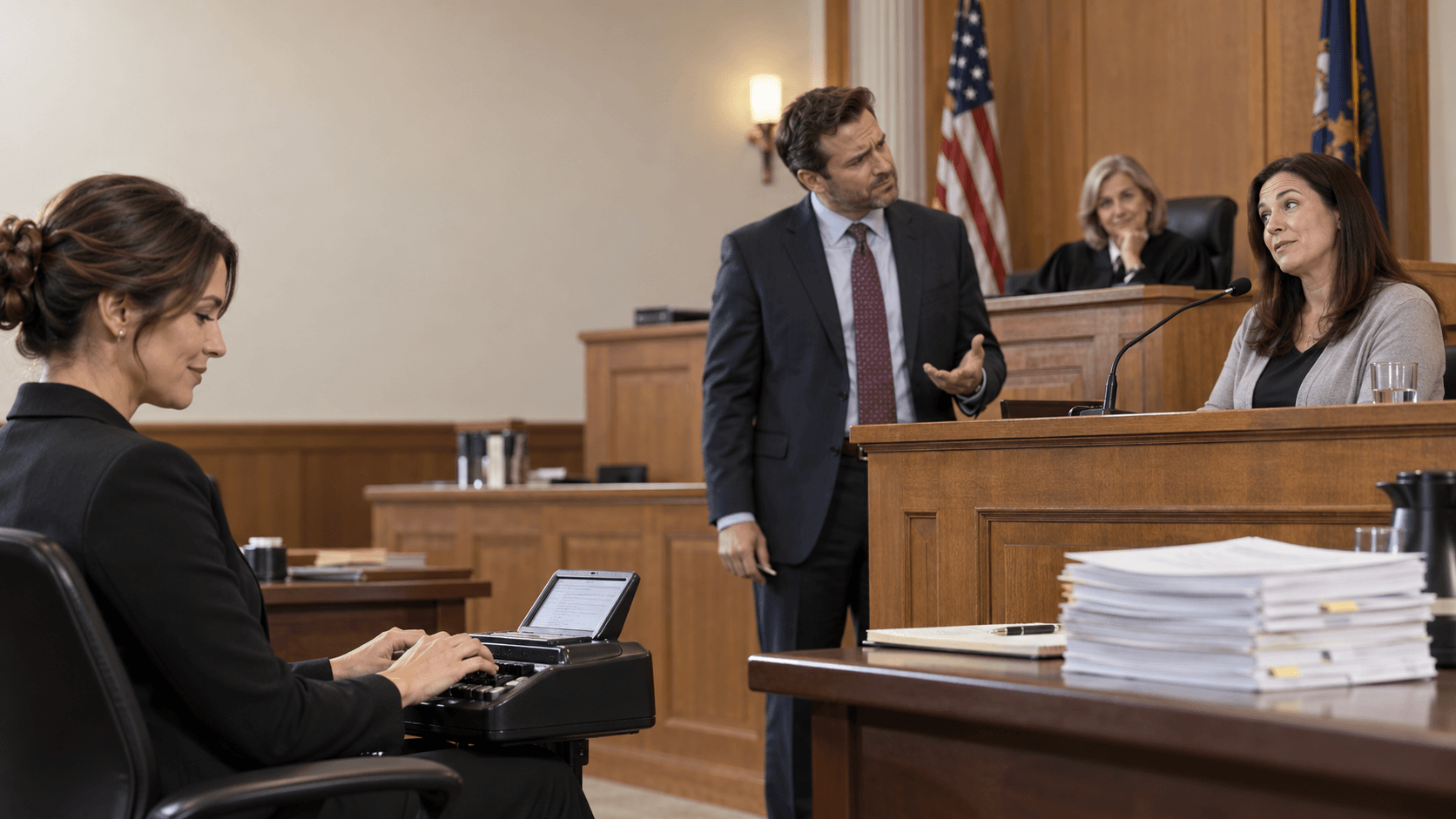
Lawyers spend years learning how to ask precise questions.
Witnesses occasionally spend three seconds destroying that precision with one perfectly literal answer.
Welcome to Part IX of our courtroom comedy series, where the questions may be serious, the setting may be formal, and the answers may still make you wonder whether everyone in the room heard the same sentence.
This time, we’re focusing on one of the most reliable sources of courtroom humor:
the witness who answers exactly what was asked — not what the attorney meant.
For court reporters, these moments are especially interesting because the humor usually depends on the exact wording. Change one phrase, clean up one sentence, or “help” the speaker a little too much, and the whole meaning changes.
And court reporters cannot do that.
Their job is to take the record down verbatim. Even when they know a speaker misspoke, used the wrong word, or clearly meant something different, they cannot quietly correct it or improve it for readability.
The record stays the record.
Even when the record has jokes.
Q: So, after the anesthesia, when you came out of it, what did you observe with respect to your scalp?
A: I didn’t see my scalp the whole time I was in the hospital.
Q: It was covered?
A: Yes, bandaged.
Q: Then, later on, what did you see?
A: I had a skin graft. My whole buttocks and leg were removed and put on top of my head.
That answer starts in the hospital and somehow ends with a sentence that makes you instinctively check whether you read it correctly.
You did.
Of course, the witness is describing skin used for grafting. But the wording creates a mental image that is far more dramatic than the medical reality.
And once those words are spoken, the court reporter has exactly one job:
Write them down.
Not:
“Your Honor, I believe the witness means skin was harvested from those areas.”
Not:
“Can we maybe phrase that differently for future readers?”
Just the words.
Verbatim.
That principle is central to court reporting. The reporter may understand perfectly well what the witness intended to say, but the transcript is not a rewritten version of events. It is the record of what was actually said.
Court reporter takeaway: context may clarify meaning, but the transcript must preserve the language actually used. Sometimes the strange wording is part of what makes the testimony understandable later.
Q. Are you married?
A. No, I’m divorced.
Q. And what did your husband do before you divorced him?
A. A lot of things I didn’t know about.
This is what happens when a factual question accidentally opens a door to an entire marriage.
The attorney probably wanted an occupation.
The witness apparently had a different category of activity in mind.
There is history in that answer.
There is disappointment in that answer.
There may be three seasons of a streaming drama in that answer.
And the beauty of it is that the witness technically answered the question.
The attorney asked what he did.
She answered.
Maybe not in the format expected, but definitely with conviction.
Court reporter takeaway: witnesses often respond based on their interpretation of a question rather than the questioner’s intended meaning. The exact wording of both question and answer is what preserves that distinction.
Q. Did you ever stay all night with this man in New York?
A. I refuse to answer that question.
Q. Did you ever stay all night with this man in Chicago?
A. I refuse to answer that question.
Q. Did you ever stay all night with this man in Miami?
A. No.
And there it is.
New York?
No answer.
Chicago?
Still no answer.
Miami?
“No.”
Which raises a fairly obvious question:
If Miami gets a definite No, what exactly were those first two refusals protecting?
The witness never actually says she stayed all night with the man in New York or Chicago.
But that one little “No” in response to Miami makes the first two refusals suddenly look a lot more interesting.
It is almost as if the witness carefully locked two doors… and then casually opened a window.
That is what makes the exchange so funny. The humor is not simply that she refused to answer. It is that the one question she did answer appears to reveal something about the two she would not.
And this is precisely why the verbatim record matters.
A court reporter cannot decide:
“Well, based on that Miami answer, I think we all know what she meant about New York.”
No.
The record must show exactly what happened:
Two refusals.
One “No.”
And everyone reading the transcript can draw their own conclusions.
Court reporter takeaway: reporters do not interpret testimony, fill in implications, or clean up meaning. Their responsibility is to preserve the exact words spoken, even when those words accidentally tell a much bigger story.
Q. Miss, were you cited in the accident?
A. Yes Sir, I was so ‘cited I peed all over myself!!
This is what happens when legal vocabulary and everyday speech briefly collide at high speed.
The attorney means cited.
The witness hears something much closer to excited.
And suddenly a routine accident question has produced considerably more information than anyone requested.
You can almost imagine the attorney’s internal response:
“Okay. Thank you. That was not where I was going.”
But once again, this is why exact language matters.
The humor only exists because of what was heard, what was meant, and what was answered.
And the court reporter cannot step in and rewrite the testimony to make the misunderstanding disappear.
Court reporter takeaway: sound-alike words, accents, speed, and context can all affect testimony. Accurate reporting means capturing what was actually said, not quietly substituting what someone probably meant.
Q. Mrs. Jones, is your appearance this morning pursuant to a deposition notice which I sent to your attorney?
A. No. This is how I dress when I go to work.
Legal English strikes again.
To an attorney, “your appearance this morning” means:
Why are you here?
To the witness, it apparently means:
Let’s talk about my outfit.
And the response is wonderful because it is neither sarcastic nor complicated.
Just a perfectly reasonable answer to an entirely different interpretation of the question.
The attorney is talking procedure.
Mrs. Jones is defending the wardrobe.
Both are participating in the same deposition.
Technically.
And again, the court reporter doesn’t get to help.
No changing “appearance” to “presence.”
No inserting a helpful explanation.
No polishing the exchange so future readers understand the intended meaning more quickly.
What was said is what goes into the record.
Court reporter takeaway: legal language is not always plain language. When the two collide, the transcript preserves exactly how the misunderstanding happened.
These exchanges are funny because the witnesses often sound literal, but there’s another side to it.
Sometimes the witness isn’t misunderstanding the question.
Sometimes the question simply wasn’t as clear as the person asking it thought it was.
That’s an important distinction.
In everyday conversation, we automatically fill in missing meaning. We assume intention. We mentally repair awkward sentences. We may even repeat someone’s story later using cleaner language than they originally used.
Court reporters do not have that luxury.
They are not editors of testimony.
They are not there to make a speaker sound more polished, more grammatical, or more logical.
If someone says the wrong word, the wrong word matters.
If someone asks an awkward question, the awkward question stays awkward.
And if a witness answers “No” to Miami after refusing to discuss New York and Chicago…
Well, the transcript simply records it.
The reader gets to notice the rest.
That distinction is what makes the verbatim record so important.
One of the fascinating things about court reporting is that you see language without the edits.
No polished press release.
No second draft.
No one quietly rewriting the sentence afterward so it sounds better.
It’s real communication happening under pressure.
People hesitate.
They misunderstand.
They overshare.
They choose the wrong word.
They become extremely literal.
And occasionally, they deliver a response so perfectly timed that you couldn’t improve it if you tried.
The court reporter captures all of it.
Not an improved version.
Not a corrected version.
The actual version.
That’s part of what makes continued training so important. Strong reporting skills help maintain an accurate record when testimony is fast, confusing, technical, emotional, awkward, or unexpectedly funny.
Because you never know what the next answer is going to be.
You just know you need to get it right.
A witness who answers literally can make an attorney’s question look ridiculous.
A poorly worded question can make a perfectly reasonable answer sound bizarre.
And sometimes one tiny word — like “No” — can accidentally tell us far more than the witness intended.
But the court reporter’s role never changes.
Hear it.
Capture it.
Preserve it.
Verbatim.
Because the record isn’t supposed to show what everyone meant to say.
It’s supposed to show what they actually said.
And every once in a while, that’s a lot funnier.
Next time, we’ll look at courtroom moments where witnesses gave far more information than anyone requested.
Because sometimes a witness doesn’t just answer the question.
They answer the question, explain the backstory, provide an unsolicited review, and leave the attorney wondering how to get the deposition back on the highway.
Join us online for our newest 10-hour program. Two dates available — pick the one that works for you. NCRA/NVRA approved and pre-qualified for CEU credit in all states.
Register Now & Save $50