Live Webinar
Court Reporting, Ethics & Harassment in an AI/Digital World!
Oct 17, 2026
Nov 14, 2026
Only $149 — Save $50!
Register Now

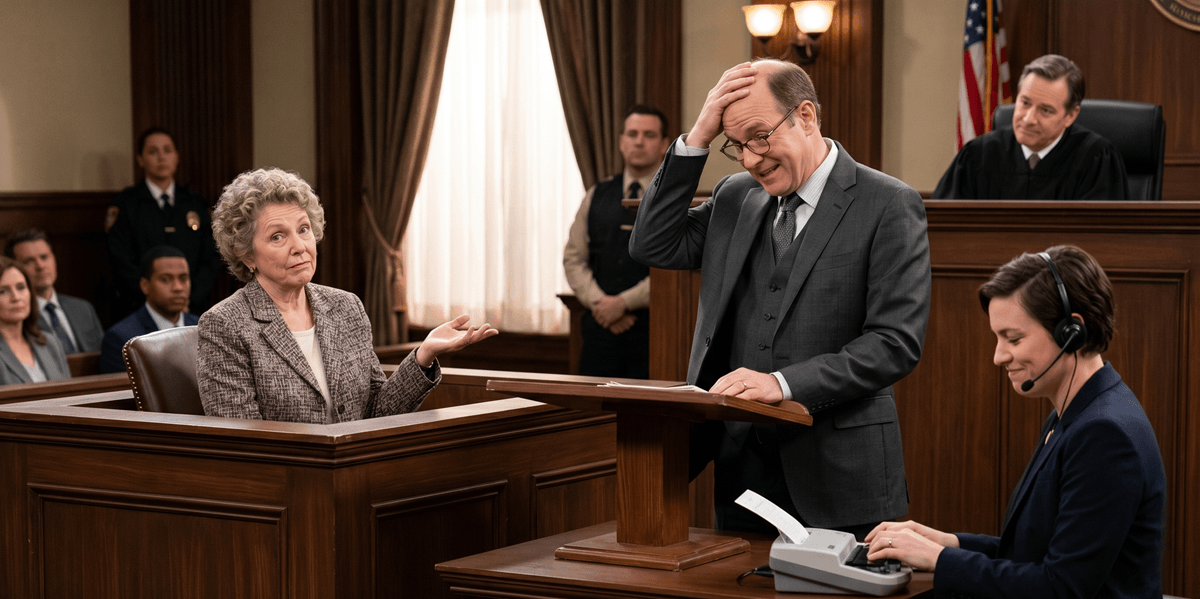
Courtrooms run on precision.
That’s the dream, anyway.
In reality, the courtroom is a place where people try very hard to be exact… and sometimes that effort produces a sentence so oddly constructed that everyone has the same thought at the same time:
“Technically… yes. But also… what?”
This is Part VIII of our courtroom humor series, and today’s theme is simple:
someone tried to sound precise, and accidentally created the funniest line in the room.
And as always, court reporters are the ones capturing it all—faithfully, neutrally, and without saving anyone from their own wording.
Here are a few fresh transcript gems from Jeff’s list that we haven’t used yet.
And the witness who answered like a time traveler
Q: (Showing man picture.) Is that you?
A: Yes, sir.
Q: And you were present when the picture was taken, right?
Somewhere, logic quietly left the building.
This is the kind of question that happens when someone is on autopilot—following a routine sequence without stopping to consider what they’re actually asking.
It’s funny because it’s “careful” in tone… but the content is basically:
“So you were there… when you were there?”
Court reporter takeaway: transcripts don’t just preserve facts. They preserve the exact wording that explains why a witness (or juror) looked confused.
(Unfortunately, the courtroom failed)
Q. Did he pick the dog up by the ears?
A. No.
Q. What was he doing with the dog’s ears?
A. Picking them up in the air.
Q. Where was the dog at this time?
A. Attached to the ears.
This exchange is like watching someone attempt to describe an optical illusion using only literal statements.
Nothing is technically wrong, yet everything feels wrong.
And then we get the closing line—“attached to the ears”—which is so perfectly matter-of-fact it almost deserves a stamp and a filing number.
Court reporter takeaway: when testimony gets weird, the transcript needs structure and clarity even more. Clean speaker changes and punctuation make a chaotic moment readable later.
Q. Mrs. Jones, is your appearance this morning pursuant to a deposition notice which I sent to your attorney?
A. No. This is how I dress when I go to work.
This is an all-time courtroom moment because it’s not a joke. It’s a sincere misunderstanding delivered with confidence.
The attorney is asking, “Are you here because of legal notice?”
The witness hears, “Are you dressed like that because of me?”
And with one perfectly calm answer, the witness turns a legal proceeding into a moment of accidental social commentary.
Court reporter takeaway: you can’t “fix” misunderstandings in the record. You preserve them—because later, that misunderstanding may matter.
Q. When he went, had you gone and had she, if she wanted to and were able, for the time being excluding all the restraints on her not to go, gone also, would he have brought you, meaning you and she, with him to the station?
MR. BROOKS: Objection. That question should be taken out and shot.
This is precision gone wild.
You can feel the speaker building the sentence like it’s a legal skyscraper… and then realizing there is no elevator, no stairs, and no safe way back down.
And Mr. Brooks? He says what the entire room is thinking, using courtroom-approved poetry.
Court reporter takeaway: long questions are where skill shows. Staying accurate through tangled phrasing is exactly why training and continuing education matter.
Q: Could you see him from where you were standing?
A: I could see his head.
Q: And where was his head?
A: Just above his shoulders
This one is comedy by geometry.
The witness answers truthfully, but not helpfully. And the follow-up question tries to squeeze more detail out… only to receive the most anatomically accurate non-answer possible.
It’s funny because it’s the kind of “technically correct” response that makes the questioner realize they are going to have to try again—using different words.
Court reporter takeaway: the record has to show what was said, even when it’s not what the questioner wanted. That distinction matters later.
Courtroom humor often comes from one place: language under pressure.
People don’t speak in perfect sentences when they’re nervous. Lawyers don’t always realize when a question is oddly phrased. Witnesses answer literally, emotionally, or defensively—sometimes all at once.
That’s why the transcript is such a big deal.
A transcript:
Court reporters provide the single most reliable version of the moment—especially when everyone else later remembers it differently.
And the better the training, the easier it is to create a clean record even when the courtroom language is doing cartwheels.
Join us online for our newest 10-hour program. Two dates available — pick the one that works for you. NCRA/NVRA approved and pre-qualified for CEU credit in all states.
Register Now & Save $50