Live Webinar
Court Reporting, Ethics & Harassment in an AI/Digital World!
Oct 17, 2026
Nov 14, 2026
Only $149 — Save $50!
Register Now

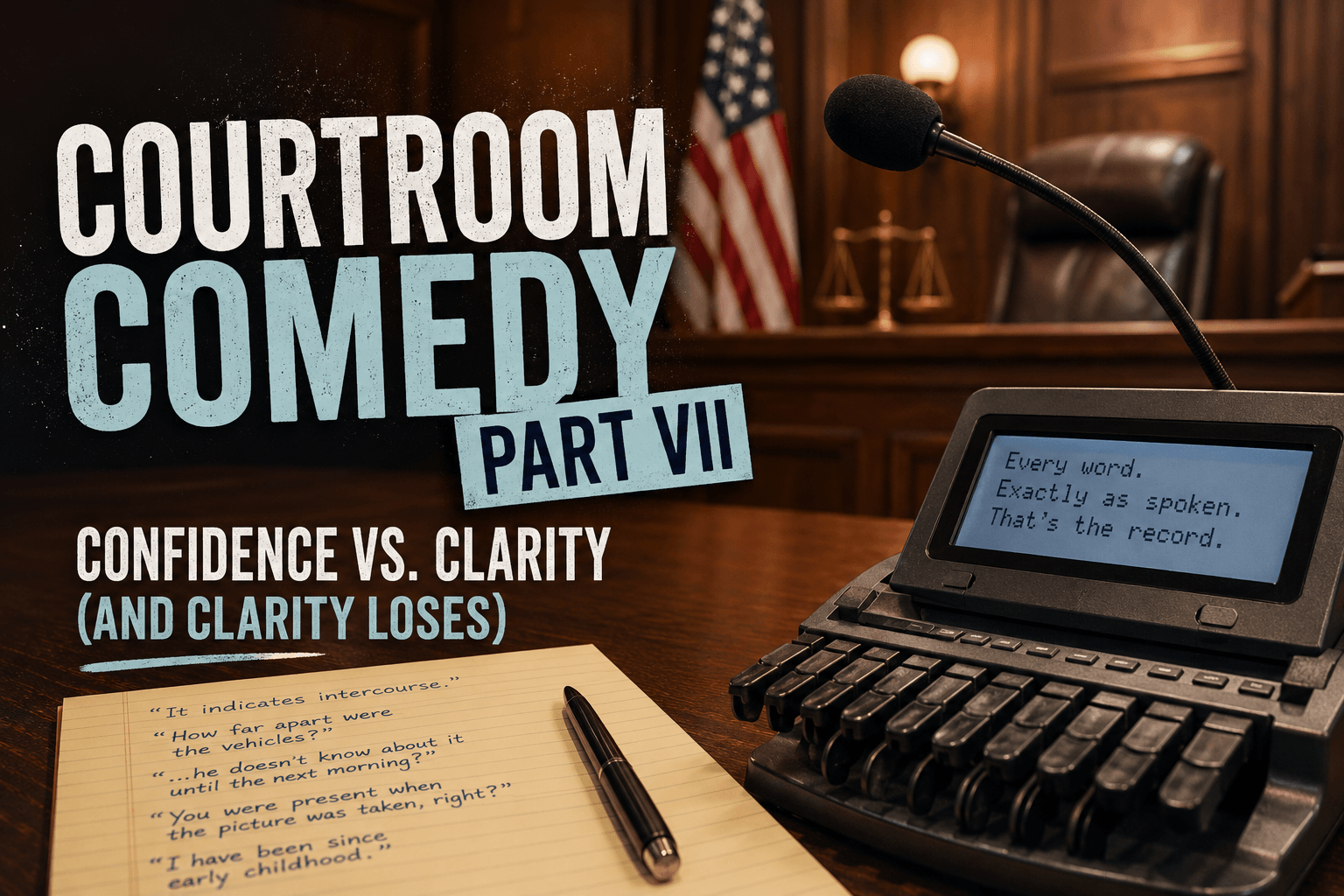
If courtrooms had a secret mascot, it wouldn’t be Lady Justice.
It would be a person confidently answering a question that was not asked… while the attorney confidently moves on as if everything is going great.
That’s the magic (and danger) of courtroom language: everyone can sound certain while meaning entirely different things.
And court reporters? They capture that collision perfectly—because a transcript doesn’t guess, interpret, or smooth anything over. It preserves the exact moment when confidence and clarity took separate exits.
Here are fresh transcript gems from Jeff’s list that we haven’t used yet—each one a small lesson in why wording matters, listening matters, and the record matters most.
A question. An answer. Two different universes.
Q: What is the meaning of sperm being present?
A: It indicates intercourse.
Q: Male sperm?
A: That is the only kind I know.
This exchange is funny because the questioner is aiming for scientific specificity, and the witness responds with a line that is both factual and unintentionally hilarious.
The attorney is thinking: “Clarify terminology.”
The witness is thinking: “Is this a real question?”
Court reporter takeaway: the record has to keep the exact wording because tone is part of meaning. Swap a single word and the whole exchange changes
The question that arrived… and then just sat there.
“How far apart were the vehicles at the time of the collision?”
This one is courtroom comedy in its simplest form because the sentence defeats itself.
If there was a collision, “how far apart” becomes a trick question—like asking, “How dry was the water?”
It’s the kind of wording that makes everyone’s brain pause for half a second, which is a lot in court time.
Court reporter takeaway: transcripts don’t just preserve answers. They preserve the exact question phrasing that can later explain confusion.
A sentence that tries to be wise and ends up being… something else.
“Now doctor, isn’t it true that when a person dies in his sleep, he doesn’t know about it until the next morning?”
This line reads like a philosophical quote from someone who has never spoken to a doctor before.
It’s confidently delivered, and that’s what makes it funny. The questioner is clearly building toward a point, but the wording takes a detour into: “So… dying is basically a surprise you discover after breakfast?”
Court reporter takeaway: confidence doesn’t equal clarity. The record shows exactly where a question’s logic drifts.
A follow-up that accidentally becomes the punchline.
Q: (Showing man picture.) Is that you?
A: Yes, sir.
Q: And you were present when the picture was taken, right?
This is the courtroom version of asking, “And were you there when you were there?”
It’s funny because it sounds like a standard, careful follow-up… until your brain catches up and realizes the answer is basically guaranteed unless we’re dealing with time travel.
Court reporter takeaway: this is why “routine” questions can be the funniest. People go on autopilot, and the transcript catches it.
A question that got a résumé response.
Q: Are you qualified to give a urine sample?
A: Yes, I have been since early childhood.
This answer is a masterpiece because it’s polite, literal, and completely unstoppable.
The questioner meant “are you able to provide one right now?”
The witness heard “do you possess the qualifications to perform this act?”
And then proceeded to confirm a lifetime of experience.
Court reporter takeaway: when wording is vague, witnesses fill in the blanks. The transcript shows exactly what those blanks became.
These are funny, but they also show a real courtroom truth:
People can be confident and confused at the same time.
Questions can be formal and unclear at the same time.
Answers can be “correct” and unhelpful at the same time.
In the middle of that, the transcript becomes the anchor—the one thing that doesn’t rely on memory, tone, or “what I meant.”
That’s why court reporting is a skill profession. And it’s why continuing education matters: it keeps your writing sharp when the room gets fast, the wording gets messy, and the testimony starts drifting into accidental comedy.
Next time, we’ll cover courtroom moments where someone tried to be precise… and accidentally created the funniest sentence in the room.
Because sometimes the transcript doesn’t capture a joke.
It captures an attempt at seriousness that tripped over one word.
Join us online for our newest 10-hour program. Two dates available — pick the one that works for you. NCRA/NVRA approved and pre-qualified for CEU credit in all states.
Register Now & Save $50