Live Webinar
Court Reporting, Ethics & Harassment in an AI/Digital World!
Oct 17, 2026
Nov 14, 2026
Only $149 — Save $50!
Register Now
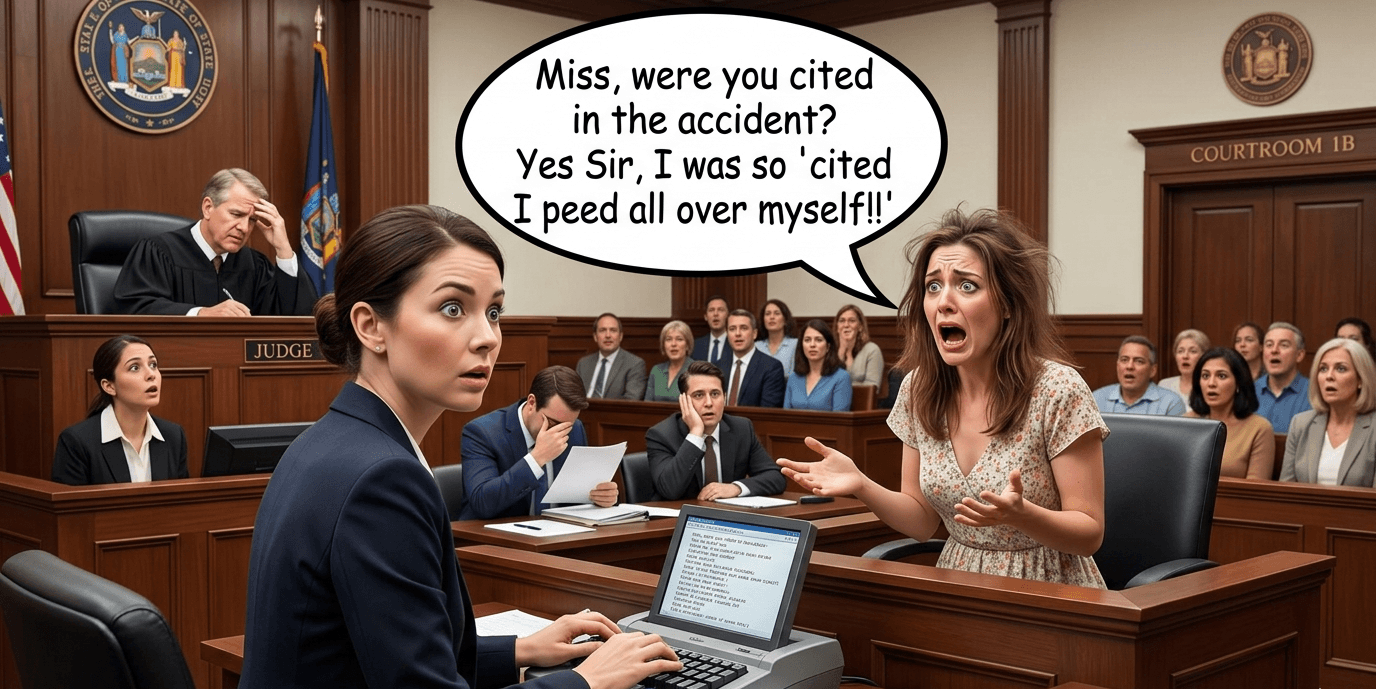
Courtrooms are built for precision. Titles, procedures, sworn testimony, rules of evidence—everything is designed to keep things orderly.
And then someone opens their mouth.
Not to be funny. Not to make a scene. Just to answer a question, the way their brain interprets it in the moment… which is how you end up with lines that sound like they were written by a comedy writer who specializes in legal chaos.
For court reporters, this is the job in its purest form: capture exactly what was said—even when it feels like the language is doing backflips. No cleaning it up. No “what they meant was…” Just the record, faithfully preserved for all time (and for future blog posts).
Here are brand-new transcript moments from Jeff’s collection that we haven’t used yet—each one a reminder that the courtroom is serious… but humans are wonderfully unpredictable.
Q. Miss, were you cited in the accident?
A. Yes Sir, I was so ‘cited I peed all over myself!!
This is what happens when a question contains a word that sounds like another word, and the witness has zero interest in pretending they’re fine.
It’s chaotic. It’s honest. It’s also a perfect illustration of why transcripts matter: the record catches not only facts, but the emotional state of a witness in real time.
Court reporter note: That apostrophe is doing a lot of work here.
THE COURT: Now, as we begin, I must ask you to banish all present information from your minds, if you have any.
This is the kind of line a judge says when the room is already operating at a level of confusion that cannot be fixed with a simple “Let’s proceed.”
Also, it’s a rare public acknowledgment of something many of us suspect:
Some days, the courtroom runs on caffeine, habit, and hope.
The funniest part is the gentle insult at the end: “if you have any.”
A polite mic drop from the bench.
Court reporter takeaway: judicial comments matter. Even the offhand ones. Especially the offhand ones.
Q. When he went, had you gone and had she, if she wanted to and were able, for the time being excluding all the restraints on her not to go, gone also, would he have brought you, meaning you and she, with him to the station?
MR. BROOKS: Objection. That question should be taken out and shot.
Every profession has its poetry. This is courtroom poetry.
We’ve all heard a sentence that started with confidence and ended with everyone silently counting how many commas it needed to survive.
But this one is special because it includes:
Court reporter truth: sometimes the hardest part isn’t speed. It’s surviving the grammar.
Q: Could you see him from where you were standing?
A: I could see his head.
Q: And where was his head?
A: Just above his shoulders
This is a masterclass in giving an answer that is:
You can almost hear the attorney’s internal dialogue:
“Okay. Great. Wonderful. Thank you. That’s… anatomy.”
Court reporter takeaway: witness answers can be accurate without being informative—and the record has to preserve that distinction.
Q: (Showing man picture.) Is that you?
A: Yes, sir.
Q: And you were present when the picture was taken, right?
This question has the energy of someone on autopilot. It’s a classic “checkbox” follow-up that forgets what photos are for.
The witness could’ve answered with sarcasm, but the question already did the work.
It’s funny because it’s so earnest. The attorney isn’t trying to be silly—they’re just moving fast, following a script, and the script briefly loses contact with reality.
Court reporter takeaway: the record captures the difference between prepared questions and real-world logic.
Sure, these lines are laugh-out-loud. But they also highlight the hidden difficulty of the job:
A court reporter has to be ready for anything:
Because the transcript is what remains when memory fades and everyone later swears, “That’s not what I said.”
And this is exactly why continuing education matters. Not in a vague “professional development” way, but in a real-world, practical way:
Better skills = cleaner record, even when the courtroom language gets wild.
Next time, we’ll visit the courtroom’s greatest category of confusion: questions that accidentally answered themselves, and witnesses who helped… in the most unexpected way possible.
Because sometimes the funniest thing in court isn’t the answer.
It’s the question that never should’ve been asked in the first place.
Join us online for our newest 10-hour program. Two dates available — pick the one that works for you. NCRA/NVRA approved and pre-qualified for CEU credit in all states.
Register Now & Save $50